Vitamin C can make aging worse
Reactive Oxygen Species (ROS) are damaging byproducts of metabolism that accelerate aging. The antioxidant vitamin C is commonly included in anti-aging skincare with the belief that it lowers ROS concentration in skin cells.
But we’ve found that actually vitamin C increases ROS concentration in human skin cells when they are exposed to Ultraviolet A, which is in sunlight. This suggests vitamin C is pro-aging, not anti-aging, when applied to skin exposed to sunlight. So, your present skincare might be doing the exact opposite of what it claims.
By contrast, our IF1 skincare’s vitamin C content is deliberately low (rather than high), making it the safe option. It has a different active ingredient, our IF1 protein, which greatly decreases Reactive Oxygen Species (ROS) generation and thereby ROS concentration, whereas vitamin C tries to neutralize ROS, which can flip and increase ROS.
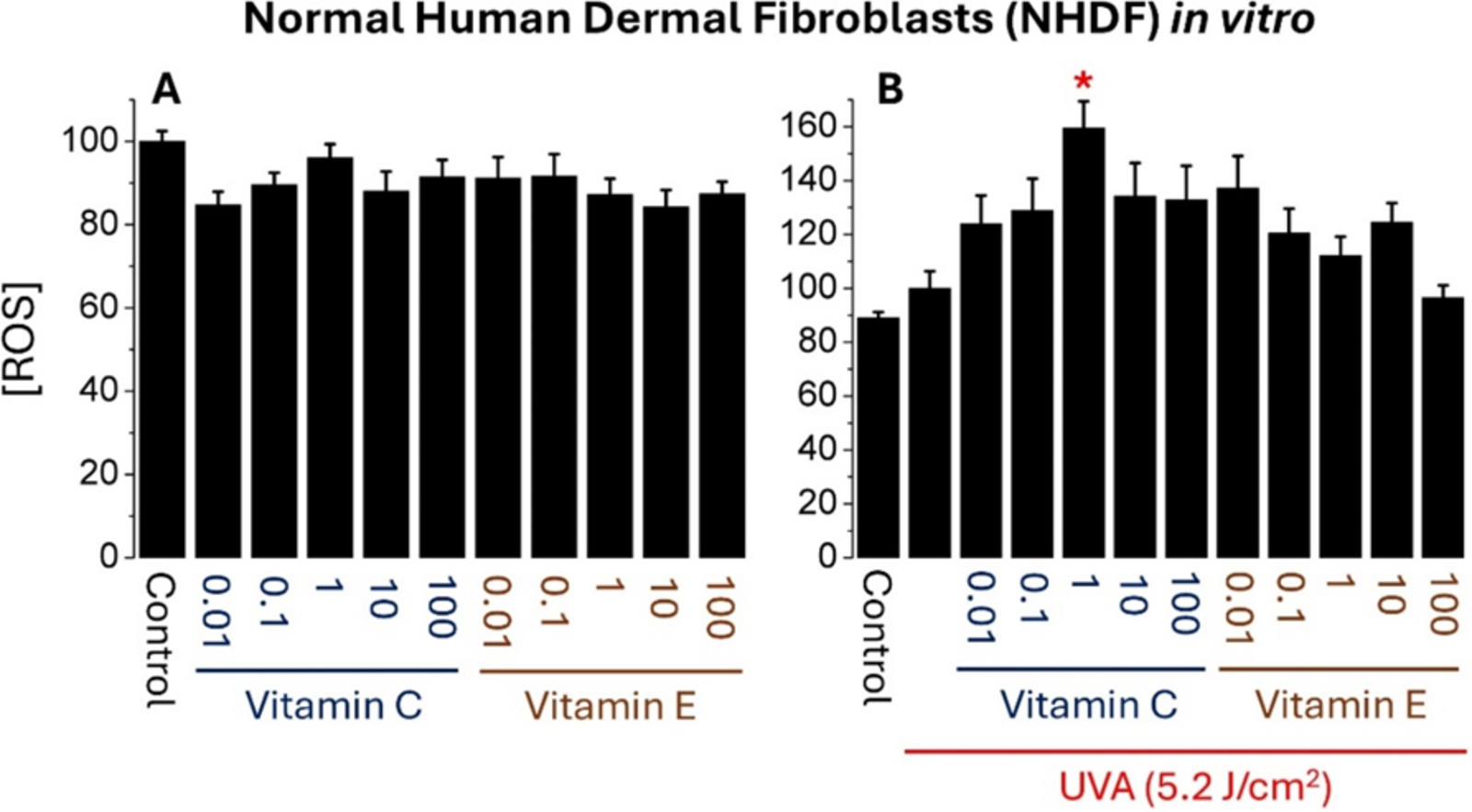
In the figure above, [ROS] is Reactive Oxygen Species concentration. UVA is Ultraviolet A at a typical intensity in sunlight. This figure shows that with vitamin C and UVA, ROS concentration is higher (not lower) than when vitamin C is absent. The same phenomenon is observed with a different antioxidant, vitamin E, which is another common ingredient of anti-aging skincare that we (by contrast) minimize. Incidentally, from our chemistry expertise, we predicted this result before we observed it, which is why we looked for it.
Protect your skin day and night with peace of mind — choose IF1 skincare.