Almitrine is a New Cancer Drug?
IF1 is the consumer longevity brand of Biophysical Therapeutics, which is a company that invents and develops new drugs, especially for cancer, the diseases of aging (such as Alzheimer’s), and aging itself.
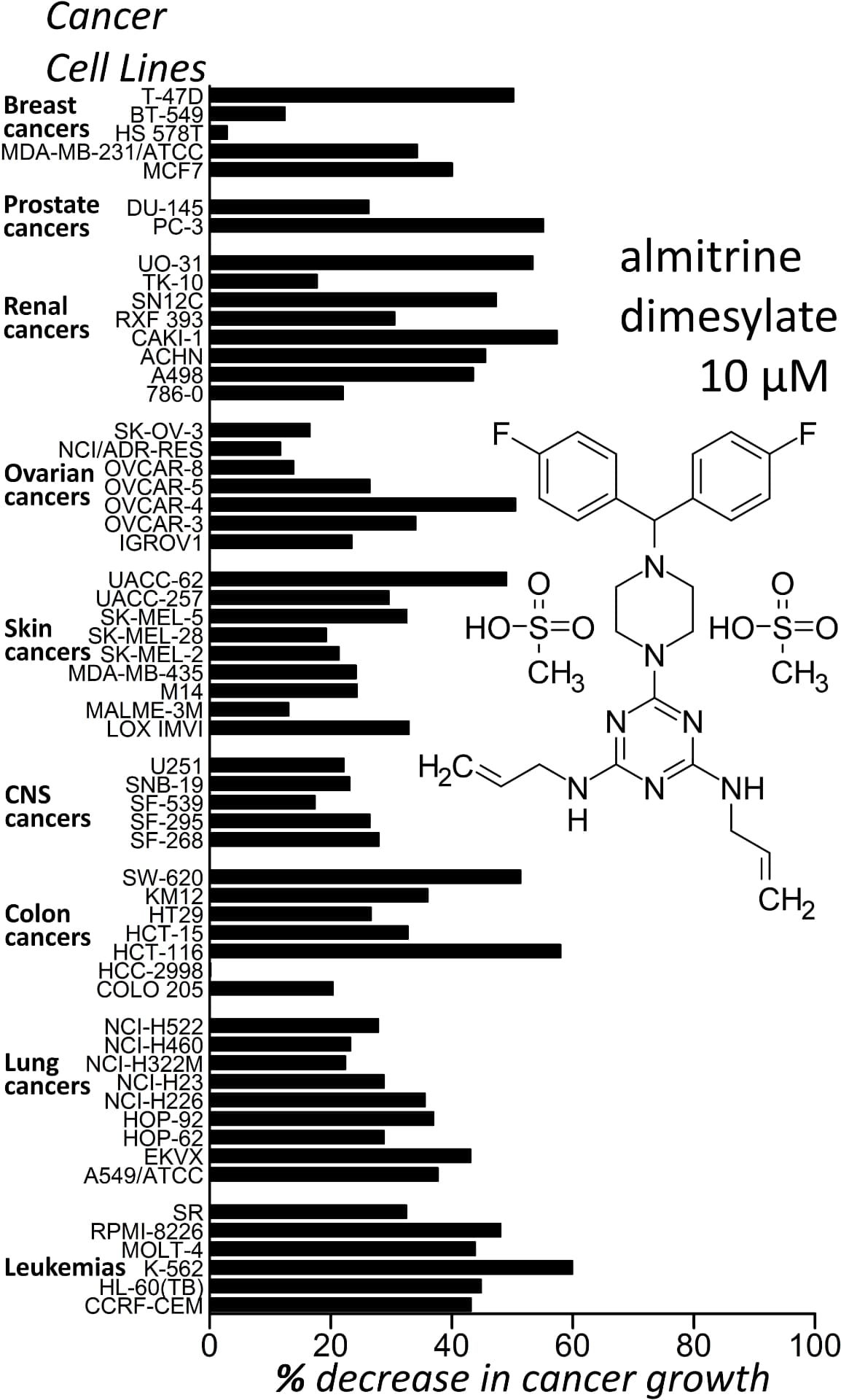
As an aside to inventing completely new drugs, we’ve discovered a new use for an old drug: discovering that the emphysema drug almitrine has anticancer activity. This wasn’t a random discovery but was something that we predicted beforehand, by inventive rationale, and then tested. We hold granted patents upon this new inventive use, including in the USA.
We’ve only shown almitrine’s anticancer activity in vitro to date, but this was across a diversity of different human cancers from different tissues, including lung cancers, and it allowed us to find cancer biomarkers that predict how responsive a patient’s cancer will be to this drug. This showing was in collaboration with the National Cancer Institute (NCI) in the USA, and so it is independently validated.
Critically, almitrine is already known to work as a drug in humans, shown to spread and accumulate throughout the human body (including in the brain), and to be very safe in humans, even at much higher concentrations in the body than we’ve shown anticancer activity at in vitro. Indeed, compared to present cancer drugs almitrine has incredibly minor side effects. In fact, next to no side-effects in most people! A small minority get peripheral neuropathy but only after long-term use (e.g., years), and this is reversible upon its discontinuation. By comparison, present cancer drugs cause horrific side-effects, which actually kill many (!), and that cause many others to rescind their consent to treatment. Chemotherapy commonly causes irreversible peripheral neuropathy. So, almitrine might be useful when less severe side-effects are (especially) important, such as with elderly cancer patients. It can be taken orally at home. Upon any side-effects, its use can be merely discontinued, and the human data is clear that they should then discontinue also.
Almitrine has been around for decades and it has been used for millions of patient months. However, it is no longer commonly used for emphysema because its side-effect profile, although low compared to present cancer drugs, can’t be justified given its limited clinical benefit for emphysema as compared to alternative treatments for emphysema, such as supplemental oxygen. So, its use for emphysema has been withdrawn by notable regulatory bodies. But it does improve lung function though, increasing blood oxygen, and this might be an added benefit to using it for lung cancer, which can disrupt breathing.
Cancer drug candidates commonly succeed in animal studies but then fail in humans. Symmetrically, there are likely to be cancer drug candidates that fail in animal studies, and are abandoned, but that would have succeeded in humans. Indeed, this species gap might be contributory to our lack of progress against cancer. By contrast, given its decades of use already in humans, almitrine is ready to be tested in human cancer patients today.
But that requires money and investors don’t like to invest in new uses for old drugs because it can be hard to attribute whether a drug sale is for the new or the old use, and so who (if anyone) should get paid. However, fortuitously, almitrine is not presently approved for any clinical use in most countries, including in the USA, and so upon an anticancer approval all sales would be easily attributable to this anticancer use. This makes it investible, and thence doable.
The novel method that we developed to predict cancer responsiveness to almitrine is more general and it can be used to predict a patient’s cancer’s responsiveness to other anticancer drugs. So, it can be used to select the best cancer drug for a patient’s specific cancer, which is a method that we have filed patents for in order to try to commercialize it, to get it to patients. Moreover, symmetrically, this method can be used to select the best patients to enrol in a new cancer drug’s clinical trial, to increase the odds of its clinical trial success. The huge costs of clinical trial failures are a monumental drag on the pharmaceutical industry and progress, and so anything that could reduce that drag would be very valuable.
Millions of people die of cancer per year. We are doing extremely inventive work to try and stop this. The stakes are literally life and death. Please consider supporting our medical research, which is diverse spanning different drug projects for varied diseases and disorders, by choosing our IF1 skincare (actual science-based skincare from actual scientists) or donating.